
After working with hundreds of commercial properties across Lubbock, I’ve seen firsthand how carpet maintenance—or the lack thereof—directly impacts a company’s bottom line. The conversation around professional carpet cleaning has evolved far beyond aesthetics. Today’s business leaders recognize that the condition of their flooring represents a measurable financial asset that requires strategic management.
High-traffic commercial environments face unique challenges that residential properties simply don’t encounter. When you’re dealing with hundreds or thousands of foot impressions daily, the wear patterns, soil accumulation, and fiber degradation accelerate exponentially. The question isn’t whether you need professional intervention—it’s how much money you’re losing by delaying it.
The Hidden Costs of Neglected Commercial Carpeting
Most facility managers and business owners underestimate the financial impact of deteriorating carpet systems. The costs extend well beyond the eventual replacement expense, creating a ripple effect throughout your operation.
Premature Replacement Expenses
Commercial-grade carpeting represents a substantial capital investment. Quality installations in office buildings, hotels, or retail spaces can easily run into six figures. Without proper maintenance protocols, carpets that should last 10-15 years often require replacement in half that time. I’ve walked into Lubbock businesses where carpets installed just four years prior looked ready for the landfill—simply because they lacked consistent professional care.
The math is straightforward: if you invested $50,000 in carpeting designed to last twelve years, premature replacement at year six doubles your annual flooring cost from roughly $4,200 to $8,400. Multiply that across multiple locations or large square footage, and you’re looking at budget impacts that affect other operational areas.
Employee Health and Productivity Impacts
Carpets in commercial environments function as massive air filters, trapping dust, allergens, bacteria, and particulates. While this protects indoor air quality initially, saturated carpets become pollution sources themselves. I’ve consulted with Lubbock businesses experiencing increased employee sick days and complaints about air quality, only to discover their carpets hadn’t received deep cleaning in over two years.
Research consistently shows that indoor air quality directly correlates with employee productivity, cognitive function, and absenteeism rates. When you calculate the cost of reduced productivity or increased health-related absences, the investment in professional carpet maintenance becomes remarkably cost-effective.
Customer Perception and Brand Value
First impressions form within seconds, and your flooring plays a starring role in that initial judgment. Stained, worn, or visibly soiled carpets communicate neglect—a message that extends to assumptions about your entire operation. Whether you’re running a hotel, medical facility, law office, or retail establishment, prospects make immediate quality assessments based on your environment.
I’ve worked with commercial clients who invested heavily in marketing and customer acquisition, only to lose potential business because their physical space didn’t match their brand promise. One Lubbock professional services firm actually tracked new client conversion rates before and after implementing a quarterly professional cleaning schedule—they documented a 23% improvement in prospect-to-client conversion.
The ROI of Professional Commercial Carpet Cleaning
When business owners ask me about the return on investment for professional carpet maintenance, I point to four concrete financial benefits that justify the expense multiple times over.
Extended Asset Lifespan
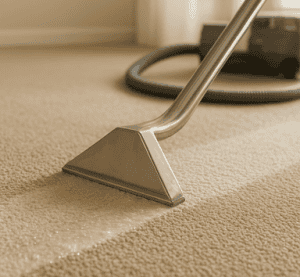
Professional cleaning doesn’t just make carpets look better—it fundamentally extends their functional life. The primary enemy of carpet fibers isn’t foot traffic alone; it’s the abrasive soil particles ground into the pile with every step. These particles act like sandpaper, cutting and damaging fibers at the microscopic level.
Regular professional extraction removes these damaging particles before they can destroy your investment. Businesses following quarterly maintenance schedules routinely achieve 100-150% of the manufacturer’s expected lifespan. That’s not just extending replacement timelines—it’s reducing your annual flooring costs by 40-60%.
Improved Indoor Environmental Quality
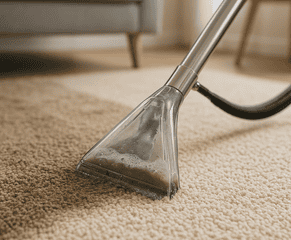
The connection between clean carpets and healthier indoor environments isn’t speculative—it’s documented and measurable. Professional hot water extraction removes allergens, bacteria, dust mites, and volatile organic compounds that accumulate in carpet systems. For businesses in Lubbock’s dry, dusty climate, this is particularly critical.
Healthier indoor environments translate to reduced HVAC strain, fewer employee health complaints, and improved air quality metrics. Several commercial clients have actually achieved lower insurance premiums after implementing comprehensive facility maintenance programs that included regular professional carpet cleaning.
Warranty Compliance and Protection
Most commercial carpet warranties include specific maintenance requirements, typically mandating professional cleaning at defined intervals. Failure to comply doesn’t just void your warranty—it eliminates your recourse if premature wear or manufacturing defects appear. I’ve seen Lubbock businesses lose tens of thousands in potential warranty claims because they couldn’t document proper maintenance protocols.
Professional cleaning services provide documentation that protects your warranty coverage and your investment. This alone can justify the maintenance expense if issues arise with your flooring system.
Operational Efficiency and Scheduling Flexibility
Establishing relationships with professional carpet cleaning providers creates operational advantages beyond the cleaning itself. Scheduled maintenance allows for predictable budgeting, prevents emergency situations that disrupt business operations, and gives you priority access during urgent situations.
The businesses I work with appreciate knowing their flooring maintenance happens on schedule, without requiring management attention or creating operational disruptions. This predictability has value that’s difficult to quantify but easy to appreciate. For comprehensive commercial carpet care solutions, resources like https://carpetcleaning-lubbocktx.com/ provide the professional expertise that high-traffic environments demand.
Calculating Your Specific Business Case
Every commercial environment has unique factors that influence the optimal cleaning frequency and approach. However, you can develop a preliminary business case using some straightforward calculations.
Baseline Cost Analysis
Start by documenting your current carpet investment:
- Total square footage of commercial carpeting
- Original installation cost or replacement value
- Current age of installed carpeting
- Manufacturer’s expected lifespan
- Current maintenance costs (in-house cleaning, spot treatments, etc.)
Next, calculate your annual carpet cost by dividing the replacement value by the expected lifespan. A $60,000 carpet system with a ten-year lifespan represents a $6,000 annual expense. If premature wear forces replacement at seven years, that annual cost jumps to $8,571—a 26% increase.
Professional Maintenance Investment
Professional commercial carpet cleaning costs vary based on square footage, soil levels, accessibility, and service frequency. However, quarterly maintenance for a typical 5,000-square-foot commercial space generally runs $1,500-2,500 annually in the Lubbock market.
When you compare this investment against the cost of premature replacement, the value proposition becomes clear. Spending $2,000 annually to protect a $60,000 asset and extend its lifespan by 30-50% delivers exceptional returns.
Implementation Strategies for Commercial Environments
Developing an effective commercial carpet maintenance program requires more than scheduling periodic cleanings. The most successful approaches I’ve implemented combine several complementary strategies.
Establish Maintenance Zones
Not all areas of your facility experience equal traffic or soiling. Entrances, corridors, and high-traffic zones require more frequent attention than private offices or low-traffic areas. By mapping your facility into maintenance zones, you can optimize cleaning frequency and budget allocation.
High-traffic zones might require monthly or bi-monthly professional cleaning, while moderate-traffic areas perform well with quarterly service. This targeted approach maximizes your maintenance budget while ensuring critical areas always present well.
Integrate Daily Maintenance Protocols
Professional cleaning delivers optimal results when supported by effective daily maintenance. This includes:
- Proper entrance matting systems to capture soil before it reaches carpeting
- Daily vacuuming with commercial-grade equipment featuring HEPA filtration
- Immediate spot treatment protocols for spills and stains
- Regular furniture repositioning to prevent permanent traffic patterns
These practices don’t replace professional cleaning—they extend the time between services and improve overall results.
Document Everything
Maintaining detailed records of all carpet maintenance activities protects your warranty, supports insurance claims if needed, and provides data for optimizing your maintenance schedule. Document dates, services performed, products used, and any observations about carpet condition or problem areas.
This documentation proves invaluable when making replacement decisions, filing warranty claims, or demonstrating facility maintenance standards to clients, inspectors, or stakeholders.
Selecting the Right Commercial Carpet Cleaning Partner
The quality of your maintenance outcomes depends heavily on your service provider’s expertise, equipment, and approach. After decades in this industry, I can tell you that not all commercial carpet cleaning services deliver equivalent results.
Essential Qualifications to Verify
Look for providers with specific commercial experience, not just residential cleaning backgrounds. Commercial environments require different equipment, techniques, and products than residential applications. Verify that potential partners carry appropriate insurance, employ trained technicians, and use truck-mounted extraction systems rather than portable units.
Certifications from organizations like the Institute of Inspection, Cleaning and Restoration Certification (IICRC) indicate professional training and commitment to industry standards. These aren’t just credentials—they represent knowledge that protects your flooring investment.
Communication and Flexibility
Commercial cleaning often requires after-hours scheduling, rapid response capabilities, and coordination with your operational requirements. The right partner understands that your business can’t shut down for carpet cleaning and develops service approaches that minimize disruption.
Establish clear communication channels, documented service agreements, and emergency response protocols before you need them. The middle of a crisis isn’t the time to discover your cleaning provider can’t accommodate urgent requests.
Making the Investment Decision
If you’re still treating commercial carpet cleaning as a discretionary expense rather than strategic asset management, you’re likely leaving money on the table. The business case isn’t complicated: professional maintenance costs a fraction of premature replacement while delivering benefits that extend throughout your operation.
The most successful commercial property managers and business owners I work with in Lubbock view carpet maintenance as they do HVAC service, pest control, or any other preventive system—essential, scheduled, and non-negotiable. This mindset shift transforms carpet cleaning from a grudging expense into a value-generating investment.
Your carpeting represents significant capital, influences employee health and productivity, shapes customer perceptions, and impacts your brand value. Managing this asset strategically through professional maintenance isn’t just good practice—it’s sound business strategy that delivers measurable returns.
The question isn’t whether you can afford professional commercial carpet cleaning. It’s whether you can afford not to invest in protecting one of your facility’s most visible and valuable assets.